Child Nutrition - What Are The Basic Rules?
 Author: Joe Fowler
Time for reading: ~3
minutes
Last Updated:
August 08, 2022
Author: Joe Fowler
Time for reading: ~3
minutes
Last Updated:
August 08, 2022
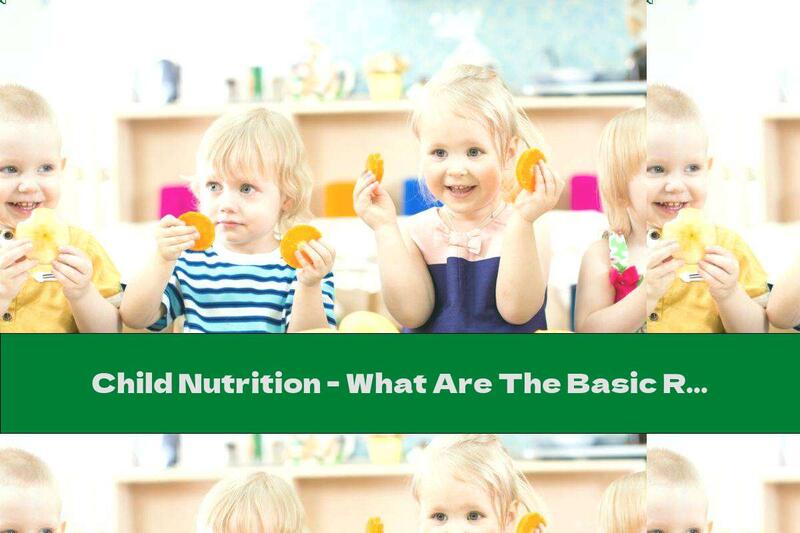
Complete and healthy nutrition is very important for raising a healthy and rarely sick child. Here's what the menu should include
Providing quality and varied food is undoubtedly a prerequisite for raising a healthy child. It is no coincidence that the principles of healthy eating are increasingly talked about during pregnancy and in the first years of life. It is believed that this has a significant impact in the short and long term on the predisposition of the child to a number of diseases. In fact, a person's lifelong diet has a direct impact on his or her health.
In this article we will look at the principles of healthy eating in preschool and school children, when children begin to show their food preferences and are often defined as "villains".
The child's menu must meet the following requirements, which reflect his fast metabolism, high physical activity, the specifics of growth and others:
- To provide all the necessary nutrients, ie. the menu should be complete;
- The energy composition should meet the needs for the specified age;
- To contain food that the child consumes with pleasure;
- To be prepared quickly and economically profitable;
- To also contain some "extras", such as sweet things.
Creating such an "ideal" menu is not always easy, but it is a prerequisite for raising a healthy and rarely ill child.
The child's food must contain the full range of nutrients - proteins, carbohydrates, fats, each of which has its own importance. When compiling a complete menu, it is usually not necessary to give additional food supplements, vitamins and immunostimulants with a controversial composition and effect.
The table below shows the daily or weekly needs of the child according to his age.
| Food products that make up 80% of energy needs | Unit |
Quantity according to age
|
|||
| 4-6 years | 7-9 years | 10-12 years | 13-14 years | ||
| Drinks, including water | ml / day | 800 | 900 | 1000 | 1200 |
| Bread, cereals | d / day | 70 | 200 | 250 | 280 |
| Potatoes, rice, pasta | d / day | 120 | 140 | 180 | 200 |
| Vegetables | d / day | 180 | 200 | 230 | 250 |
| Fruits | d / day | 180 | 200 | 230 | 250 |
| Milk or milk products * | ml / day | 350 | 400 | 420 | 450 |
| Meat, meat products | d / day | 45 | 55 | 65 | 75 |
| Eggs | pcs / week | 2 | 2 | 2-3 | 2-3 |
| Fish | d / week | 100 | 150 | 180 | 200 |
| Oil | d / day | 25 | 30 | 35 | 35 |
| Food products that make up 20% of energy needs | Unit | 4-6 years | 7-9 years | 10-12 years | 13-14 years |
| For example Sweets | d / day | up to 50 | up to 50 | up to 80 | up to 80 |
| Sugar, marmalade | d / day | to 10 | to 10 | to 20 | to 20 |
* 100 ml of milk in calcium content corresponds to 30 g of cheese
The food products in the first part of the table must provide 80% of the daily energy needs. The remaining 20% is for the "favorite sweet things" that may be present in the menu, but in no case should prevail.
The quantities presented are indicative and show large variations from child to child, depending on growth rate, physical activity, health status, etc.
Below we will look in detail at the main food products and their composition.
1. Carbohydrates
These include the so-called complex carbohydrates - bread, cereals, potatoes, rice, pasta and others. They are the main source of energy for the body .
Whole grain foods contain more vitamins, including - B vitamins (B1, B6), as well as trace elements - iron, magnesium. They also contain fiber (fiber), protein and unsaturated fats. For this reason, it is important that at least half of the carbohydrates consumed are whole grains . For example, wholemeal bread is especially suitable, and children often take it well.
On the other hand, children's breakfast cereals are highly processed and can contain up to 40% sugar . For this reason, they are not suitable for everyday consumption.
The main menu should also include potatoes, rice, pasta , which can be used as a side dish. Due to their nature, they are relatively low in fat, unless it applies to french fries, for example. They also contain calcium, vitamin C, protein. Usually children consume them with pleasure, so they are often an integral part of the menu.
Related Articles
- The Ultimate Guide to Hickory Smoked Bacon in Nutrition and Healthy Eating
- Fruitskewers in Honey Syrup: Nutritional Benefits and Recipes
- The Ultimate Guide to Buffer 500 in Nutrition: Benefits and Usage
- Nutritional Benefits of Fruit Skewers in Honey Syrup: A Delicious and Healthy Recipe
- Nutrition Guide: Fruitskewers in Honey Syrup - Benefits, Recipes, and More
Top Nutrition Articles Today
- . Steak Label
- . Healthy Food For Modern Man
- . Amino Acids in Nutrition: Importance, Types, and Optimizatio...
- . How To Know The Real Ice Cream?
- . Sea Buckthorn: Health Benefits And Harms
- . The Diet �������� 7: A Comprehensive Guide to Nutrition and...
- . How To Fry Porcini Mushrooms
- . The Ultimate Guide to Calcium Inosinate in Nutrition: Benefi...
- . Net Zero
- . Lychee - A Small Fruit, But Useful And Tasty