How To Cook "Food In A Test Tube" Or The Products Of The Future - Recipe
 Author: Joe Fowler
Time for reading: ~1
minutes
Last Updated:
August 08, 2022
Author: Joe Fowler
Time for reading: ~1
minutes
Last Updated:
August 08, 2022
Learn how to cook "Food in a test tube" or the products of the future ". Delicious recipe.
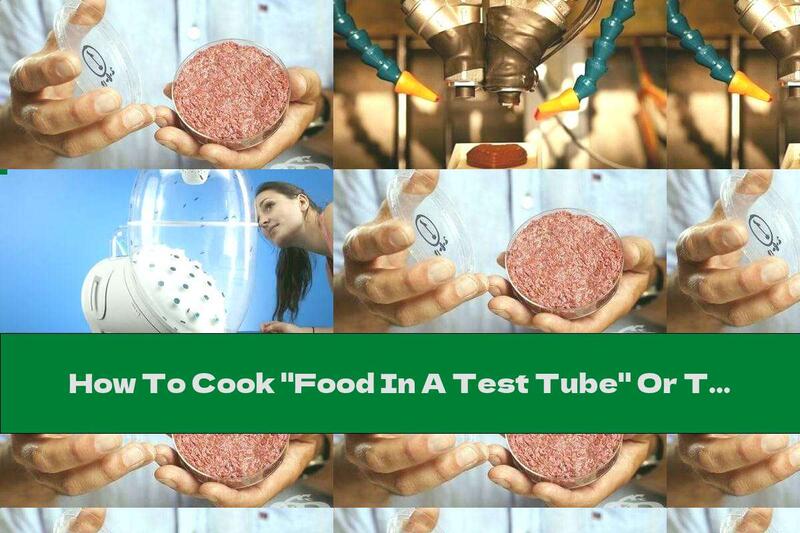
The world's first hamburger made with ... artificial meat is presented in London . Meatballs for him are made of artificial minced meat, created from cow stem cells. This experience can not be said to be completely successful. Two of the tasters (author of a cookbook and culinary researcher) are of the opinion that the meat is not juicy enough, but in general the true taste of the beef has been preserved.
This is by no means the only product created with the help of high technology. To find out what similar attempts to replace real food with artificial are made, just keep reading.
With the growing popularity of 3D printing, a number of researchers are trying to "print" food as well. In 2011, British scientists came up with a prototype printer printing chocolate . A year later, the "device" can now be purchased through the website of one of the researchers of the innovation. The home "Chocolate Factory" works on the principle of an ordinary printer. You have to put a picture of an elephant, for example, and you will get a huge copy of the animal, made layer by layer. Of course, it is necessary to load the machine with chocolate.
In the United States, there is a promising meat printing project . The company Modern Meadow develops a technology that uses cells (muscle tissue, fat, etc.) from animals and the nutrient medium are amino acids, vitamins, minerals, salts, sugars. At the exit, a jelly-like tissue should be obtained, which, thanks to the electrical stimulation, acquires the texture of muscle tissue. The authors promise that the first sample will be released this year.
Insects with the taste of french fries . One of the latest biased screams in the food industry - protein-rich insects, properly prepared for consumption. Fly larvae are placed in the space provided for this in a device developed by a German industrial designer. They fall into a "sleeve" where they grow and turn into flies. They then move to a large space where they produce offspring. From there, they end up either in a cup in which they will be fried, or in the previous "compartment" and continue the production cycle.
Related Articles
- The Power of Honeysuckle: Health Benefits and Recipes
- Fruitskewers in Honey Syrup: Nutritional Benefits and Recipes
- Nutritional Benefits of Fruit Skewers in Honey Syrup: A Delicious and Healthy Recipe
- Nutrition Guide: Fruitskewers in Honey Syrup - Benefits, Recipes, and More
- The Role of Flour in Nutrition: Types, Benefits, and Recipes