How To Cook The Pot - What To Choose - Recipe
 Author: Karen Lennox
Time for reading: ~3
minutes
Last Updated:
August 08, 2022
Author: Karen Lennox
Time for reading: ~3
minutes
Last Updated:
August 08, 2022
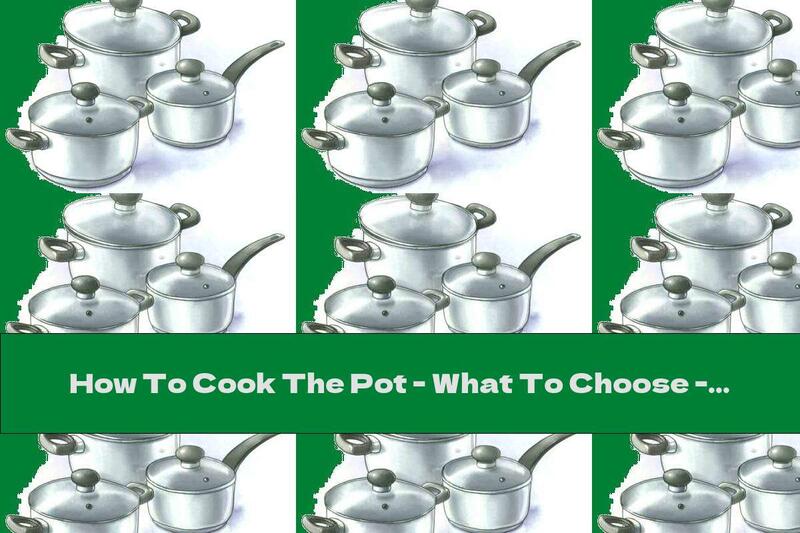
In this article, learn more about How To Cook The Pot - What To Choose - Recipe. Learn how to cook "The pot - what to choose". Delicious recipe..
Every good housewife has at least 3-4 different pots in her kitchen:
- Large (with a capacity of 4-5 liters) - for cooking pasta, broths, for preparing larger quantities of food. It is good to have a non-stick coating, fireproof handles and a lid so that it can be placed in the oven;
- Medium (2.5-3 liters) and small (1-1.5 liters) - for preparing small amounts of food and for making sauces.
What materials are they made of?
Stainless steel
Food in stainless steel pots stays warm longer, but due to the low thermal conductivity, more time is needed to process the products. If the dish has a bottom of several layers: aluminum, copper and bronze, sealed in stainless steel, the thermal conductivity of the pot is much higher - the heat is distributed more evenly, the food burns less. The pot made of stainless steel or made on the basis of alloys is universal, but it is difficult to withstand excessive loads. Do not leave an empty pot on a hot plate, as blue stains may appear that cannot be removed.
Cast iron
Cast iron is a completely harmless material. Food cooked in a cast iron pot is healthy and clean. Due to the fact that the dish must simmer for a long time in it, it turns out very tasty and fragrant. Be sure to wipe the container before and after use with oil - this will improve its non-stick properties and allow you to store food in the pot (not long).
Ceramics and glass
The thick walls of ceramic and glass dishes heat up slowly and evenly. The food simmers in them, not boiled; the vegetables remain juicy and the meat soft. The dish stored in such containers does not spoil for a long time. But you should know that ceramic and glassware should not be placed on an open fire, the oven is best for them. Their disadvantages are only two: fragility and sensitivity to temperature changes. After washing, it is good to dry. Another important point is to store the dishes - to keep them open, without lids, because otherwise an unpleasant odor is possible.
Enameled pots are extremely suitable for making soups, broths, pickles, compotes. But they should not be fried and stewed. The enamel and metal of the pot have different thermal conductivity - the surface heats up unevenly and the food will burn.
The enameled vessels are :
- Safe. Glass-coated metal containers are considered to be the safest, as glass enamel is inert and resistant to food acids, reacts with the products and does not change their taste.
- Hygienic and does not cause allergies. The enamel layer is a colored glass mass. The thin coating, along with the glass, is the best material for making dishes from a medical point of view. It certainly protects food from contact with metal. People allergic to nickel are advised to use only glass and enameled dishes and utensils.
- Practical and easy to maintain. The strength of the enamel coating allows the dish to be easily washed with any detergents and to use a dishwasher.
- Comfortable. Such dishes can be used in any hob (gas, glass-ceramic ...), because they are characterized by a flat bottom, whose thickness is not less than 3 mm).
- Durable. Combining the mechanical properties of steel with the chemical, optical and thermal properties of glass, enameled vessels do not deform and are resistant to mechanical damage.
Aluminum
The main advantage of aluminum cookware is the affordable price. In addition, they are light, have good thermal conductivity, which ensures rapid heating of food. For boiling milk, for example, there is no more suitable pot than the aluminum one, because it will not burn in it. But it should be known that ready meals should not be stored in such pots.
The lid
The lid must correspond to the size of the pot and close it tightly. Otherwise, the contents will boil more slowly, which is a cost of electricity. The presence of an opening in the lid through which the steam can escape can reduce the pressure if necessary and thus will prevent the liquid from "escaping".
The handle
Do not place a pot with a wooden or plastic handle in the oven. The first thing you need to do when you get a new item is to read the product description and instructions for use. In general, metal handles, which are welded or placed with the help of rivets, are suitable, but do not forget about the handles.
Related Articles
- The Power of Honeysuckle: Health Benefits and Recipes
- Fruitskewers in Honey Syrup: Nutritional Benefits and Recipes
- Nutritional Benefits of Fruit Skewers in Honey Syrup: A Delicious and Healthy Recipe
- Nutrition Guide: Fruitskewers in Honey Syrup - Benefits, Recipes, and More
- The Role of Flour in Nutrition: Types, Benefits, and Recipes
Top Nutrition Articles Today
- . Calcium In Lentils
- . How To Cook Puff Pastry Hot Dog Pie - Recipe
- . The Nutritional Benefits of Scotch: Improving Cardiovascular...
- . The Power of Red Foods: Health Benefits and Nutrition Guide
- . Nutrition Boost: Functional Properties in Muffins for Health...
- . Diet After Surgery Of The Small And Large Intestine
- . The Ultimate Guide to Using Ammonium Carbonate in Baking
- . The Ultimate Guide to Creating a Well-Structured Diet Plan f...
- . Understanding Raising Agents E450, E500, E501 in Nutrition:...
- . The Ultimate Guide to Non Starchy Carbs: Benefits, Examples,...