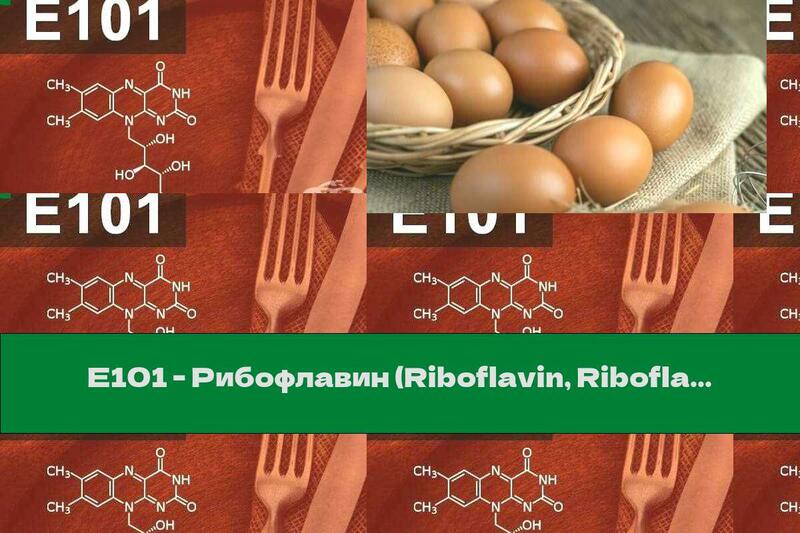
E101 - Рибофлавин (Riboflavin, Riboflavin-5 -phosphate)
 Author: Joe Fowler
Time for reading: ~3
minutes
Last Updated:
January 27, 2026
Author: Joe Fowler
Time for reading: ~3
minutes
Last Updated:
January 27, 2026
CHAPTERS (Table Of Contents)
Vitamin B2 (riboflavin, lactoflavin) is one of the most important water-soluble vitamins. It is a biologically active substance that plays an important role in human health. It appears as a coenzyme.
Vitamin B2 (riboflavin, lactoflavin) is one of the most important water-soluble vitamins. It is a biologically active substance that plays an important role in human health. It appears as a coenzyme (one of the most important redox enzymes) in many biological processes. The chemical formula of riboflavin is C17H20N4O6. Represents yellow-orange crystals with a bitter taste.
The food supplement is considered safe and even useful when consumed with food. As a colorant E101 is approved for use in food in Russia, Ukraine and many other countries.
Origin of food additive E101 (riboflavin)
The discovery and research of B vitamins began in the 1920s and 1930s. Riboflavin was artificially synthesized in 1935. Then it gets its name, which comes from "ribose" (sugar) and "flavin" (yellow paint). It gets this name because its molecule consists of two substances - ribose (bicarbonate) and flavin - a natural yellow pigment found in some vegetables, potatoes and milk.
Properties on riboflavin (E101):
The food supplement E101 is resistant to high temperatures, but is destroyed by exposure to light - it becomes inactive and loses its useful properties.
It is slightly soluble in water and alcohol. It is resistant to acidic environments, but decomposes rapidly to alkaline.
The supplement can be obtained chemically from 3,4-dimethylaniline and ribose, as well as microbiologically from the fungus Eremothecium ashbyii or with the help of genetically modified bacteria Bacillus subtilis.
Riboflavins are classified into 2 types of compounds:- Supplement E101i - pure riboflavin;
- Supplement E101ii - riboflavin 5-phosphate.
Effect of the supplement E101 on the body
BenefitsVitamin B2 in the form of the supplement E101 is essential for the health of nails, hair, skin, as well as for the work of the thyroid gland. Riboflavin is needed for the formation of erythrocytes and antibodies, as well as for regulating the growth and reproductive functions of the body.
In case of insufficient receptionVitamin B2 deficiency in the body is expressed by the following external signs:
- damage to the mucous membrane of the lips;
- cracking and peeling of the epithelium;
- sores on the edges of the mouth;
- swelling and redness of the tongue;
- seborrheic dermatitis of the nasolabial folds, nose, ears, eyelids.
Changes in the visual organs often occur:
- photophobia;
- corneal vascularization;
- conjunctivitis;
- keratitis and, in some cases, cataracts.
There are a number of cases when avimitanosis leads to anemia, nervous disorders, manifested in muscle weakness, burning pain in the legs, muscle weakness and others.
The main reason for vitamin B deficiency in the body is the low consumption of milk and dairy products, which are its main source. Also chronic diseases of the gastrointestinal tract and taking drugs - antagonists (blockers) of riboflavin.
It is important to consume foods that contain vitamin B2 constantly, as it cannot accumulate in the body. Any excess is excreted in the urine. When there is a lot of it, the urine turns yellow.
It hurtsThe food supplement E101 is practically non-toxic, even in case of excessive consumption of products with its content. Because riboflavin is slightly soluble in water, it is poorly absorbed by the gut. Only synthetically produced riboflavin may pose a minimal risk due to the likelihood that synthetic by-products will enter its composition.
Use of riboflavin (E101)
In the food industry, the additive E101 is used as a yellow food coloring. It is added to foods to enrich them with vitamin B2. Most often E101 is included in children's cereals, bread, peanut butter and cereals.
In nature, riboflavin is naturally found in protein products of animal origin. Foods with the highest vitamin content are liver and kidneys, meat (poultry, etc.), fish, eggs, almonds, mushrooms, cottage cheese, buckwheat (buckwheat), milk, meat, yeast and others. It is also found in some vegetables such as broccoli, spinach, white cabbage and others.
Riboflavin is used in medicine as a dietary supplement to supplement the lack of vitamin B2 in the body.
- E150 (d) Ammonia sulphite caramel
- E124 Ponso 4R, Cochineal red A
- E133 Blue shiny FCF
- E120 Cochineal, Carminic acid
Related Articles
Top Nutrition Articles Today
- . List of Foods that Contain Carrageenan: A Guide to Avoiding...
- . Sea Buckthorn: Health Benefits And Harms
- . Healthy Food For Modern Man
- . The Importance of Micronutrients in Chicken: A Complete Guid...
- . The Truth About Potato Chips: Health Effects and Alternative...
- . The Power of Pear Puree: Nutrition, Health Benefits, and Rec...
- . Can You Take A Bath When You Have A Cold?
- . The Diet �������� 7: A Comprehensive Guide to Nutrition and...
- . Steak Label
- . Fruit Juices That Can Interact With Medications