E1201 - Polyvinylpyrrolidone
 Author: Marko Balašević
Time for reading: ~4
minutes
Last Updated:
August 08, 2022
Author: Marko Balašević
Time for reading: ~4
minutes
Last Updated:
August 08, 2022
CHAPTERS (Table Of Contents)
Polyvinylpyrrolidone (E 1201) can be used as a thickener, stabilizer and clarifier. This substance is a biopolymer, a mixture of amphoteric linear polymers with varying viscosity. It is a white hygros
Polyvinylpyrrolidone (E 1201) can be used as a thickener, stabilizer and clarifier.
This substance is a biopolymer, a mixture of amphoteric linear polymers with varying viscosities. It is a white or yellowish hygroscopic powder without taste and with a specific odor. Dissolves in water and alcohol; insoluble in ether and aliphatic hydrocarbons. It is highly hygroscopic. It melts at a temperature of 150-180 ° C, and when heated above 150º it loses its ability to dissolve in water and organic liquids. The viscosity of aqueous solutions is stable at all pH levels; is chemically resistant. E 1201 forms complexes with inorganic and organic compounds.
It is used as a thickener and gel-forming agent in the making of toothpastes, foam stabilizer in detergents. Forms an excellent transparent layer and is a fixative in hair care products. It has moisturizing and lifting effects. It is not toxic.
Common feature
Polyvinylpyrrolidone is the main name of the product. In the European codification of food additives it is registered with code E 1201. Its other names are: PVP (PVP); polyvidone; povidone; poly-N-vinylpyrrolidone; poly- [1- (2-oxo-1-pyrrolidinyl) ethylene.
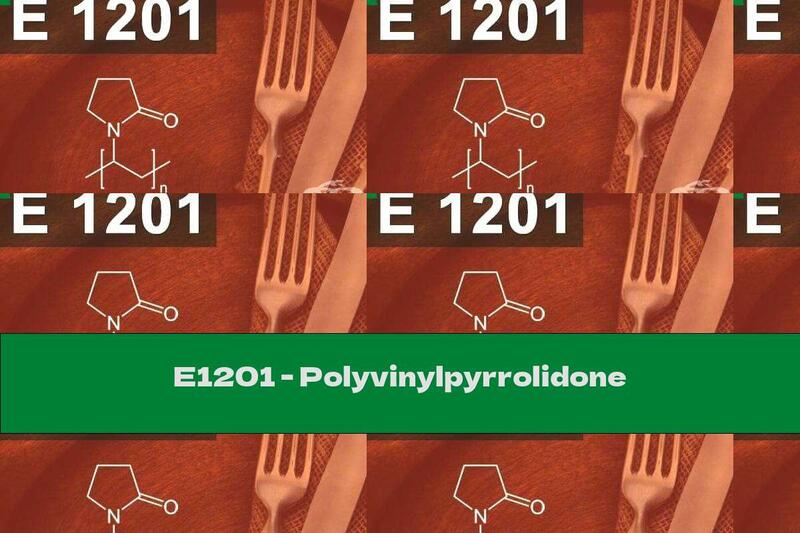
Polyvinylpyrrolidone is a derivative of acetylene. By its chemical structure, the additive E 1201 is a synthetic polymer of the organic compound N-vinylpyrrolidone. The substance is made in different ways. The most common is the radical polymerization of purified vinylpyrrolidone in the presence of ammonia and hydrogen peroxide.
A high molecular weight product (360,000) and a low molecular weight product (40,000) are used for food and medical purposes.
According to the main technological function, the additive E1201 is included in the group of substances that regulate the consistency of the products.
Packing
Due to its high hygroscopicity, the additive E 1201 is packed in double plastic bags with different volume (1, 5, 25 kg). Bags weighing 25 kg are additionally placed in rolled cardboard drums.
Use
The additive E 1201 is approved for use in various sectors of the food, pharmaceutical and cosmetic industries. In Russia, polyvinylpyrrolidone is used in food production to a limited extent. It is sometimes used as a stabilizer, thickener or filler and is included in some sweeteners for the production of food supplements in the form of tablets.
In European countries, the additive E 1201 is included in the technology for the production of beer and white wines. The introduction of polyvinylpyrrolidone into the beer at the filtration stage prevents the formation of protein and tannin complexes. The additive reduces the likelihood of taste defects, in particular bitterness due to oxidation. In the production of white wines, the additive E 1201 in the amount of 0.01-0.05 mg / l is used to reduce the iron content, which adversely affects the transparency and taste of the drink. There is no polyvinylpyrrolidone in the final product. The substance is removed by precipitation after processing the wine material. This gives the right not to indicate the presence of additive E 1201 on wine labels.
The synthetic polymer is in great demand in the pharmaceutical industry and medicine. The high solubility in water and alcohol and the ability to form complexes with various chemical compounds allows the use of the additive E 1201 as a binder in tablets. The substance accelerates the solubility, increases the bioavailability of antibiotics, sulfonamides, analgesics, chemotherapeutic drugs. The combination of polyvinylpyrrolidone with iodine (povidone-iodine complex) is a powerful disinfectant.
The drug is administered intravenously to detoxify the body in:
- infectious diseases of the gastrointestinal tract (dysentery, salmonellosis and others);
- acute food poisoning;
- neonatal toxemia;
- sepsis and other similar conditions.
Polyvinylpyrrolidone binds toxins and facilitates their passage through the renal barrier. A single injection of the drug is sufficient to remove dangerous toxins from the body.
The product for external use as part of liquid soap, surgical scrubs and ointments is used to disinfect the skin: in combination with povidone, iodine loses its scorching properties, but fully retains its bactericidal properties.
Polyvinylpyrrolidone is the colloidal basis of plasma replacement solutions. Prepared from polymer liquids are easily sterilized and stored for a long time. They can be used in patients regardless of blood type. They are used for high blood loss, large burns and surgery.
The supplement is allowed in Russia, the United States, Australia, China and European Union countries.
E 1201 is a popular component of various cosmetic products. The substance has a moisturizing and firming effect. In the manufacture of cosmetics it is used as a thickener, emulsifier and tester. The ability of the synthetic polymer to form thin transparent films on the surface is widely used in the manufacture of hair sprays and face masks.
The additive E 1201 can be found in the composition of:
- toothpastes, including for children;
- hair styling products - gels, varnishes;
- anti-aging serum;
- face masks with lifting effect;
- tonal, moisturizing, nourishing creams;
- shampoos, conditioners for hair and body - polyvinylpyrrolidone stabilizes the foam.
- used in contact lens solutions.
Benefits and harms
Once in the human body through food, polyvinylpyrrolidone is not broken down by enzymes and is not absorbed into the blood. The substance is almost unchanged excreted in the intestine. Nutritional supplement E 1201 does not irritate the mucous membranes.