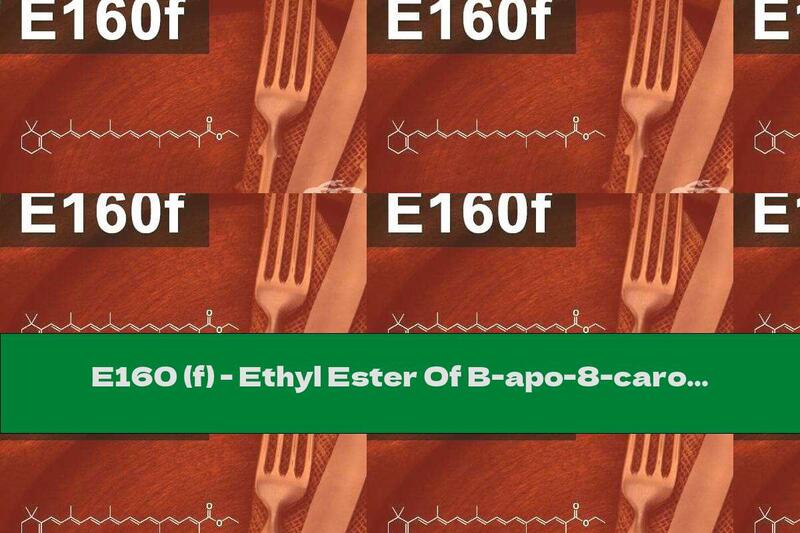
E160 (f) - Ethyl Ester Of B-apo-8-carotenic Acid (C 30)
 Author: Dean Rouseberg
Time for reading: ~1
minutes
Last Updated:
August 08, 2022
Author: Dean Rouseberg
Time for reading: ~1
minutes
Last Updated:
August 08, 2022
CHAPTERS (Table Of Contents)
The additive E 160f is a synthetic analogue of the colorant E-160a. Carotenoic acid ethyl ester; gives the products a yellow, orange, pink or red color.
Characteristics of the additive E 160f
E 160 (f) is a food additive used as a natural colorant in food and beverages. Its common name is beta-apo-8-carotenoic acid ethyl ester (C 30). The additive E 160f is a synthetic analogue of the colorant E 160a. Gives products yellow, orange, pink or red. As a consistency it can be found in crystals, crystalline powder or in the form of a solution. It is insoluble in water, almost insoluble in ethanol and vegetable oils, but highly soluble in chloroform. The supplement is not resistant to light and heat, therefore, it is often mixed with antioxidants. In small quantities, this substance is found as a natural component in some plants, but can also be commercially available from beta-apo-8-carotene (C 30), also known as the additive E 160e (carotene aldehyde). Carotenoic acid ethyl ester is a synthetic analogue of carotene.
Use of beta-apo-8-carotenoic acid ethyl ester (C 30)
The additive is used in the food industry as a colorant for products in all shades of red and orange. It is most often used for coloring pasta and bakery products, ice cream, canned fruits, sauces, spices, smoked fish, alcoholic and soft drinks. E 160f can be found in processed cheeses, citrus fruits and other foods and beverages. It is used as poultry feed, which results in a bright red or orange colored egg yolk. The colorant is also used in pharmacy and cosmetology.
Impact on humans
There are no confirmed data on negative or positive effects of the food supplement E 160f on the body. The ethyl ester of carotenoic acid has not been fully studied, so there is no information about its harm to the human body.
In most countries, the supplement is considered safe. The maximum daily dose is set at 5 mg / kg body weight. The absorption of the dye in the body is insignificant, most of it is excreted. There is evidence that the supplement E 160f can cause allergic reactions in people prone to allergies.
Related Articles
- The Role of Sodium Methyl Para-Hydroxybenzoate in Nutrition: Preservative Properties & Health Concerns
- The Ultimate Guide to Lactic Acid in Nutrition: Benefits, Food Sources, and Recipes
- The Role of Sodium Methylparaben in Nutrition: Uses, Controversy, and Safety
- The Role of Fatty Acids in Nutrition: Benefits, Sources, and Intake
- The Complete Guide to E952 (Cyclamic Acid) in Nutrition
Top Nutrition Articles Today
- . The Role of K12 in Nutrition: Benefits, Sources, and Recomme...
- . Pertussis And Pertussis Nutrition
- . The Ultimate Guide to Gatorade in Nutrition: Benefits, Usage...
- . List of Foods that Contain Carrageenan: A Guide to Avoiding...
- . Nutritional Benefits of Lasagna: Why It's a Healthy Choice
- . Omega 3 Foods
- . The Role of Hormones in Nutrition: Understanding How Hormone...
- . Carbohydrates and Lipids in Nutrition: Importance, Functions...
- . The Nutritional Benefits of Curd: Protein, Calcium, Vitamin...
- . The Ultimate Guide to E300 (Ascorbic Acid) in Nutrition