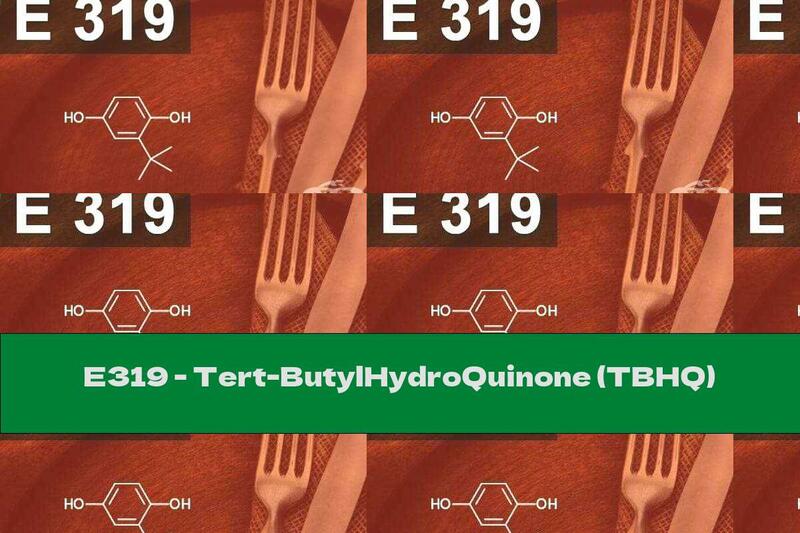
E319 - Tert-ButylHydroQuinone (TBHQ)
 Author: Nia Rouseberg
Time for reading: ~1
minutes
Last Updated:
January 27, 2026
Author: Nia Rouseberg
Time for reading: ~1
minutes
Last Updated:
January 27, 2026
CHAPTERS (Table Of Contents)
Characteristic: The food supplement E 319 belongs to the group of synthetic phenolic antioxidants. It is a yellowish-white, wax-like powder with a characteristic odor. Its solubility in alcohols,
Characteristic
Food supplement E 319 belongs to the group of synthetic phenolic antioxidants. It is a yellowish-white, wax-like powder with a characteristic odor. Its solubility in alcohols, fats and oils is good and does not dissolve in water. The additive, unlike other antioxidants, stops oxidation at an early stage, does not change the taste and aroma of the product, the color is preserved, even in the presence of iron. The substance is currently being tested.
Use
E 319 is used in the food industry in the production of vegetable and animal fats, incl. fish oil, added in dry semi-finished confectionery, dry appetizers, in concentrates for soups and sauces (up to 200 mg per kg of fat in the product). The additive is used for impregnation of packaging for products containing fats.
Butyl hydro quinol is administered separately from or together with the gallates E 310-312 (propyl gallate, octyl gallate and dodecyl gallate). It is also used to prevent the oxidation of essential oils and fragrances in the manufacture of cosmetics; for stabilization of industrial oils, waxes, varnishes.
Impact on humans
The permissible daily amount of tertiary butyl hydro quino l is 0.2 mg / kg body weight per day temporarily (this is the dose that is harmless to the body). If exceeded, nausea, vomiting, hallucinations are possible, doses up to 5 grams are lethal to humans.
As a result of a number of studies performed on experimental animals, it has been found that high concentrations of the substance can lead to the formation of gastric malignancies and DNA damage.
The supplement is not approved for use as an antioxidant in many countries, including the EU.
- E321 Butyl hydroxy toluene (BHT)
- E320 Butyl hydroxy anisole (VNA)