How To Cook How To Cook And Store Spinach - Recipe
 Author: Karen Lennox
Time for reading: ~2
minutes
Last Updated:
August 08, 2022
Author: Karen Lennox
Time for reading: ~2
minutes
Last Updated:
August 08, 2022
CHAPTERS (Table Of Contents)
In this article, learn more about How To Cook How To Cook And Store Spinach - Recipe. Learn how to cook "How to prepare and store spinach". Delicious recipe..
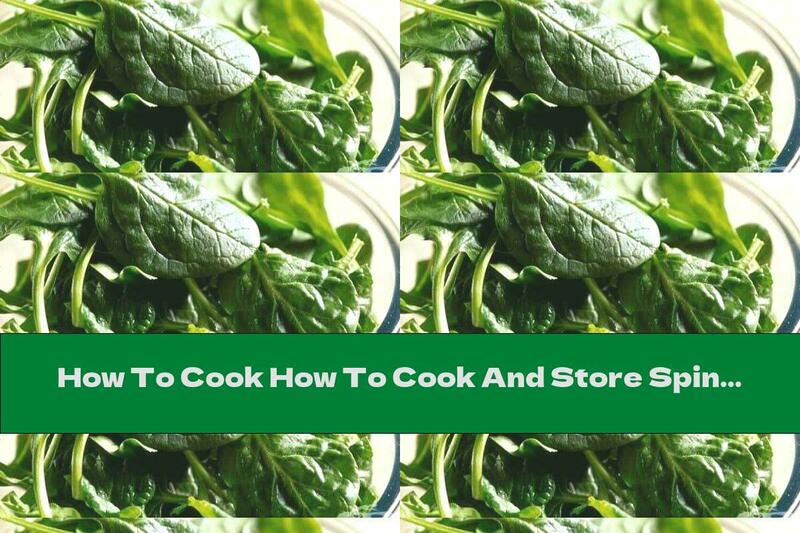
Spinach is a real storehouse of vitamins and minerals. It contains a lot of provitamin A, vitamins C, P, PP, D, also from group B. Useful green leaves are rich in iron. The amount of protein is ranked immediately after peas, green beans and meat, and the first place is occupied by the presence of iodine, which invigorates and slows down aging. And something very important: all these substances are resistant to cooking and canning.
As for the contraindications, we must say that the composition of vegetables includes a large amount of oxalic acid, which requires limited consumption of the product by children and people suffering from kidney stones, gout, liver and bile diseases. It is believed that the acid is neutralized by boiling spinach in milk or liquid cream, and in fresh leaves it is not a cause for concern.
We distinguish between winter and summer spinach, as the leaves of the first are darker in color.
How to store spinach?
Wrap unwashed leaves in a damp cloth and store in the refrigerator for no more than two days. Before use, wash the spinach and remove the faded parts.
If you want to keep a plant for a longer time, freeze it.
How to cook spinach?
The plant has many useful properties, but the main thing that makes it valuable and preferred in cooking, perhaps, is its rich emerald color, which is not affected by any heat treatment.
Spinach is boiled without water. For this purpose, the leaves are washed, cut and placed in a saucepan. The dish is closed with a lid and placed on the stove for a few minutes. During this time, turn the spinach several times. Then drain the liquid and pour the leaves into a sieve. Of course, you can also pour water, but its amount should be minimal. If you add a little olive oil, it will contribute to better absorption of fat-soluble vitamins.
A few minutes (5-7) stewing or steaming are enough to make the spinach tender.
Heat treatment reduces or completely destroys vitamin C in spinach. 100 grams of fresh leaves contain 28.1 mg of the vitamin. After suffocation, the amount of ascorbic acid drops to 9.8 mg / 100 g.
Fresh spinach is good to use in salads and for making sauces. Older and coarser leaves are steamed, fried or stewed.
The plant goes very well with bacon, cream, nutmeg, cheese, pine nuts, tomatoes and chickpeas.
Related Articles
- The Power of Honeysuckle: Health Benefits and Recipes
- Fruitskewers in Honey Syrup: Nutritional Benefits and Recipes
- Nutritional Benefits of Fruit Skewers in Honey Syrup: A Delicious and Healthy Recipe
- Nutrition Guide: Fruitskewers in Honey Syrup - Benefits, Recipes, and More
- The Role of Flour in Nutrition: Types, Benefits, and Recipes
Top Nutrition Articles Today
- . Carbs to Sugar Conversion Chart: Monitoring Carb and Sugar I...
- . The Role of Monosodium in Nutrition: Understanding MSG and M...
- . How To Cook Omelet With Potatoes, Onions, Bacon And Tomatoes...
- . Milkshake With Oatmeal, Dried Apricots And Ginger Syrup
- . Nutrition for Cerebrospinal Fluid (CSF): Useful Foods and Ti...
- . Chicory: 15 Health Benefits, How To Drink, Contraindications...
- . Useful Foods For The Hypothalamus
- . School-Aged Child Nutrition - Nutrients and Energy
- . The Role of K12 in Nutrition: Benefits, Sources, and Recomme...
- . How To Cook Lunch For School: Meatballs, Babaganush, Sarma,...