Preparation And Postures For Breastfeeding
 Author: Joe Fowler
Time for reading: ~8
minutes
Last Updated:
August 08, 2022
Author: Joe Fowler
Time for reading: ~8
minutes
Last Updated:
August 08, 2022
CHAPTERS (Table Of Contents)
Breast milk is special and each woman is individual, with a unique composition to meet the needs of your own baby.
Women have been breastfeeding their babies since the dawn of time. However, this does not mean that breastfeeding is an easy process and all women are prepared for it. In the first weeks there will be times when you will want to stop trying and just take the bottle of formula. So before you prepare your luggage bag for the hospital and before you are disappointed with breastfeeding, get acquainted with this important process.
Breastfeeding can be difficult at first, but with patience, effort and a lot of support you will cope! You need to understand that breast milk is good for your baby and breastfeeding is good for you. Breast milk is special and each woman is individual, with a unique composition to meet the needs of your own baby.
The first experience begins in the hospital, after midwives or breastfeeding consultants guide you with advice on hygiene, proper body positioning and twisting the baby. Although the newborn instinctively knows how to breastfeed, there may be some time of trial and error: the nipple may come out of the baby's mouth or it may still be too tired and sleepy from the birth process. But you are not discouraged!
How to prepare for breastfeeding?
Prepare for breastfeeding by washing your breasts with plain water, then drying with a soft towel. It is good to avoid the use of soap or disinfectants on the nipple and areola, as they can lead to dry skin and sore nipples. If you feel strong tension in the breast, it is good to express some milk before breastfeeding so that the baby can bite the breast more easily. For greater comfort, breastfeeding women can use a nursing bra and pads, which need to be changed after each breastfeeding.
What breastfeeding position to choose?
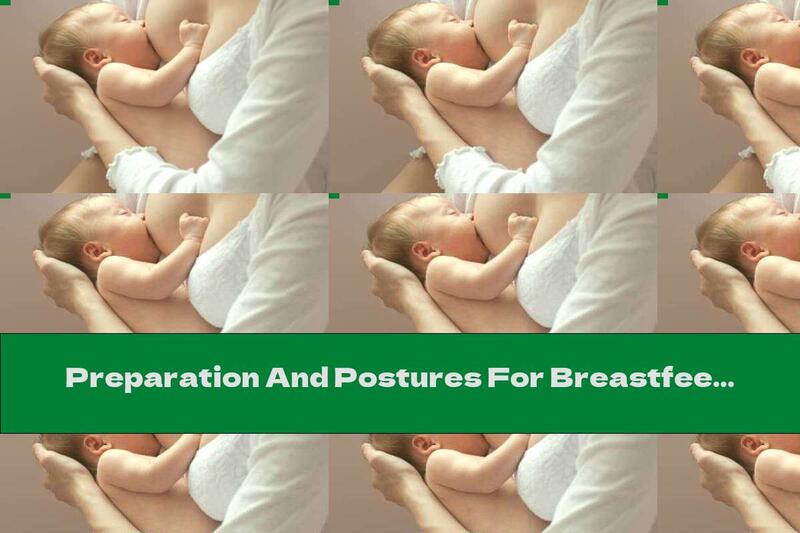
There are more than one way to breastfeed a baby, but the best is the one that is most comfortable for both of you. Start by sitting comfortably so that you do not get tired and your back does not hurt. Very often a good position is when the back is resting on pillows and the legs are resting on the floor to ensure stability. In order not to feel tired in the hands, it is good to have support under the elbows and to help hold the baby. This is done with the help of the simplest pillow or specially designed pillows for nursing mothers.
The next step is to place the baby properly on the breast. There are a variety of breastfeeding poses that you can try to determine which is most comfortable for you. Here are some of them:
Swing poseThis is a classic pose in which the baby's head is placed in the bend of the elbow, and the palm covers his buttocks. The baby's abdomen is directed towards the mother's abdomen, with his body in a straight line. Often in this position a pillow is placed under the baby for greater comfort.
Cross swing pose
Recommended in the early days when you are still in the process of adjusting and learning how to breastfeed. You need to sit comfortably, put pillows on your knees and place the baby at the level of your abdomen. You can put the arm on which it should lie so that it covers your waist. Hold the baby's body with the opposite hand on the breast with which you will breastfeed. For example: if you are breastfeeding with your right breast, you are holding your breast with your right hand and the baby's body to your abdomen with your left hand, covering the nape of your neck with your palm. The fingers of your hand hold his head.
Soccer ball pose
In this position, the baby's body is parallel to the thigh (not on the lap) with his legs behind the mother's elbow. The hand to the respective breast covers the baby's head and directs it. This position is extremely comfortable after a cesarean section and on hot days, as the baby's body and the mother do not touch each other.
Soccer ball pose for twins
If you have twins and want to breastfeed them at the same time, this is the position for you. Sit in a wide armchair with low armrests, put pillows on your lap for more comfort. Hold each of the babies parallel to your thighs with their legs behind your elbows and their backs resting on your forearms.
She lay down
In this position, the baby's and mother's bodies are sideways. The baby's mouth is the same height or slightly lower than the nipple. The mother's hand, which remains under the body, can be placed under the head for greater comfort, and with her free hand she can hold the breast with which she is breastfeeding, adjust the baby's bite or simply hug it.
Posture upright in hands
This position is suitable for older babies who can now control their head. With it, place the child on your lap, sitting on your knees, with your back in an upright position, holding it lightly with your hands.
Horse pose (leaning on his back)
Lie back after placing a pillow behind your back and place the baby on your stomach on top of you. His legs may be outstretched or cover your thigh, mimicking a seat on a horse.
Posture leaning on the back during a cesarean section
Place a pillow on it to lie on, and place the baby in a vertical position relative to your body to protect the surgical wound.
Rotational breastfeedingIt is a frequent change of the child's position - using different positions during the process, and in each of them feeding lasts 5 minutes. This ensures complete release of all parts of the mammary gland.
How to latch the baby properly?
After choosing a breastfeeding position that is comfortable for you, hold your breast and bring the baby closer to it by gently stroking his lips with the nipple of the breast so as to stimulate him to open his mouth wide.
As soon as this happens, point the nipple between the baby's lips and quickly pull it close to your body. It must bite not only the nipple, but also part of the areola (the pigmented part around the nipple) of the breast, otherwise, after only a few feedings, the nipple may become sore and sore. If the baby fails to bite the breast properly, gently interrupt the sucking act by inserting your index finger into the corner of his mouth, between the gums. Then start all over again. Continue the experiments until you are sure that the baby has twisted correctly, for which it is extremely important to make him open his mouth wide (to help him, you could press his chin slightly down with the hand holding the breast).
Another important step in breastfeeding is the baby's proper breathing. When you pull him close to you, his nose may rest on his chest and he may not be able to breathe easily. If this happens, change the angle of his body to yours or just push your breast down so that his nose is free.
At the end of breastfeeding, the baby should stand for a few minutes to burp. After eating, it should not be dried, so as not to put pressure on the abdomen, because this can lead to vomiting. It is placed in the bed in a lateral position to avoid the risk of choking and aspiration in case of vomiting.
After you have finished breastfeeding, it is good to express the breasts, as this stimulates the production of breast milk (the easiest way to do this is with the help of a breast pump - manual or electric). Squeezing usually lasts about 20 minutes, after which the breasts can be washed and smeared with a supportive protective agent.
How long should we breastfeed the baby?
The child's diet can be determined by you, in which case the intervals between feedings are about 2-3 hours or by the baby - breastfeeding on request. If you stick to breastfeeding on demand, then you will breastfeed as often and for as long as the baby wants. If you set the rules, then the duration is again individual - in the first days about 10 minutes (they are enough for the newborn to fill his stomach, and thus the nipples are protected from injury), gradually increasing to 15-20 minutes on the breast (it is good for the baby to breastfeed until you feel the breast soft and relaxed). The intervals you set between feedings should not exceed two and a half to three hours, as the milk is digested in the stomach for just as long. Within one breastfeeding, offer both breasts, to stimulate lactation! It's a good idea to try to take a break at night so that your baby's stomach can rest, but if that doesn't work, don't worry. Usually after the second month, babies give up breastfeeding on their own.
How to store breast milk?
Do not throw away expressed milk! Freshly squeezed, it can be stored at room temperature for six hours. However, its use within four hours is optimal. And if the room is particularly warm, the storage limit is four hours. You can store in the refrigerator for up to five days. Still, it is recommended to use or freeze in the freezer within three. You can keep it in the freezer for a period not longer than 6 months. It can be extremely useful for supplementing the baby when reducing or stopping lactation. The milk obtained from individual expressions must not be mixed. Defrosting should be done at room temperature or in a water bath at a temperature of 37 degrees (DO NOT use a microwave oven)!! Once thawed, breast milk should not be re-frozen. Freeze breast milk in plastic containers or plastic bags specially designed for this purpose, never overfilling them so that there is enough space for the milk to expand. Be sure to mark the date on which you freeze it!
Related Articles
- Nutrition Guide: Breastfeeding for Infants and Mothers
- The Benefits of Night Breastfeeding for Nutrition: A Complete Guide
- The Importance of Night Breastfeeding for Nutrition: Benefits for Your Baby
- Night Breastfeeding for Nutrition: Benefits, Nutritional Composition, and Recipes
- The Ultimate Guide to Breastfeeding in Nutrition: Benefits, Diets, Concerns, and Recipes