Capers - Useful Properties And Harms
 Author: Ivan Red Jr.
Time for reading: ~4
minutes
Last Updated:
August 08, 2022
Author: Ivan Red Jr.
Time for reading: ~4
minutes
Last Updated:
August 08, 2022
CHAPTERS (Table Of Contents)
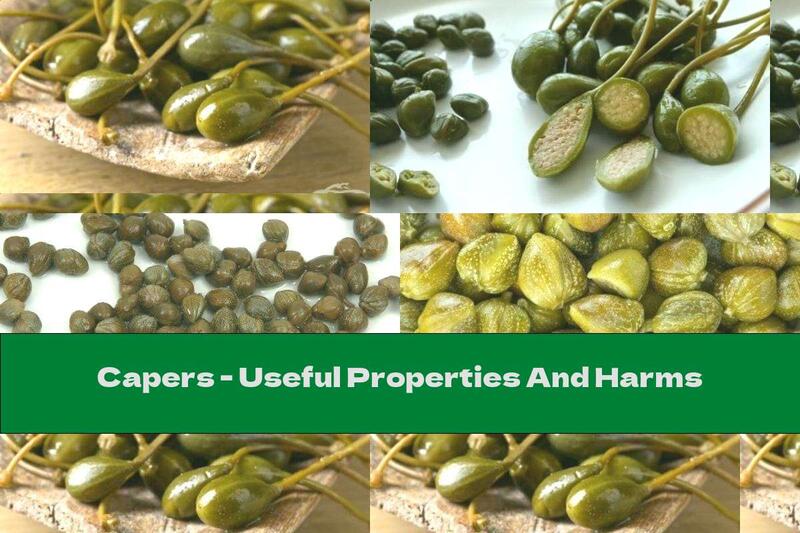
Capers are the edible buds of a shrub. They are small, round and hard. Marinated have a sour-salty and sharp taste. Low in calories, a source of powerful antioxidants, vitamins and minerals.
Capers are the edible immature flower buds of a herbaceous plant or shrub of the species Capparis spinosa. They are small, round and hard. They are washed, dried in the sun, placed in jars and preserved in vinegar or salt dissolved in oil. They have a sour-salty and slightly sharp taste. They go well with cold appetizers and main dishes of meat and fish. They are also often added to various sauces, including mayonnaise. They are grown mainly in the Middle East, Central Asia, East Africa, the Pacific Islands and Australia, although their origins are unknown.
Young shoots, buds and small fruits are used for cooking and consumption.
Nutritional composition of capers
- The fruits contain the alkaloid caparidine. They contain up to 12% sugars, up to 32% rutin, up to 136 mg% ascorbic acid, thioglycosides, steroid saponins, enzyme myrosine, red pigment, iodine.
- The buds contain: 21 - 29% protein, 3 - 4.6% fat, 0.32% rutin, up to 150 mg% vitamin C, essential oil, pectin.
- The seeds are characterized by up to 18% protein content and 26 - 36% semi-drying oil.
As flower buds, capers are actually very low in calories, delivering only 14 calories per 100 grams. They contain many phytonutrients, antioxidants and vitamins necessary for optimal health.
The buds contain vitamins A, K, niacin and riboflavin. Niacin helps lower bad "LDL" cholesterol. The minerals calcium, iron and copper are present in sufficient quantities in capers. However, the high level of sodium is mainly due to the addition of sea salt (sodium chloride) to the brine when pickling vegetables.
Health benefits of capers consumption
Since ancient times, capers have been used as a means of lowering blood pressure. Their bark or dry powder from it, or decoction is used for purulent and long-term non-healing wounds and ulcers. For this purpose, make an infusion of 2 teaspoons of powdered dry peel of capers, which are poured with 250 ml of water and boiled for 15 minutes on low heat. Once the liquid has cooled, strain it. It is said that such a decoction helps with toothache, it is also used for neurosis and hysteria.
Caper parts are used to relieve rheumatic pain in traditional medicines. Marinade capers are added to the diet to stimulate the appetite. In addition, these pimples have many useful properties to contribute to the good health of the body.
1. Rich source of antioxidantsCapers contain flavonoid compounds such as rutin and quercetin (180 milligrams per 100 grams of product), which are powerful antioxidants - molecules that inhibit the oxidation of other molecules. Oxidation produces highly reactive free radicals that can damage cells by altering the structure of DNA, proteins and other cellular structures. Antioxidants interact with these free radicals and prevent cell damage.
Studies show that quercetin has antibacterial, anticancer, analgesic and anti-inflammatory properties.
Routine strengthens capillaries and inhibits the formation of platelets in blood vessels. This helps the normal blood circulation in the capillaries and keeps the vessels healthy.
2. Help fight the risk of anemiaAnemia is a condition in which an individual does not have enough red blood cells to carry oxygen-rich blood throughout the body. A common form of anemia is iron deficiency, which occurs as a result of insufficient iron intake in the diet. Iron is an essential mineral for the body, as it is an integral part of the compound hemoglobin, which is found in red blood cells. The mineral binds to oxygen and transports it throughout the body. Without it, oxygen cannot bind and transfer to the body.
3. They have anti-inflammatory propertiesInflammation is a protective mechanism of the body when the body tries to eliminate the harmful effects on it and begin a healing process. For short periods, the inflammation can be beneficial to the body. Chronic or long-term inflammation causes cancer, rheumatoid arthritis and heart disease. Research suggests that caper extracts have powerful anti-inflammatory properties due to the compounds they contain - caffeic acid, catechin, rutin, syringic acid and fetal acid.
4. Other potential benefits- Maintains healthy bones: Vitamin K, calcium and magnesium are important nutrients found in capers and are responsible for maintaining healthy bone structure and reducing the risk of osteoporosis.
- Protect against allergies: Allergic symptoms of mild skin irritations and bronchospasm can be reduced by consuming capers and their extract.
- Maintain a healthy digestive system: They are an excellent source of dietary fiber, which can help reduce constipation.
Use in cooking
Raw buds have a neutral taste and must be marinated to obtain their unique spicy and pungent taste. Here are some recipes for what to cook with capers:
- Tuna salad, capers and roasted peppers ;
- Tuna tartare (venison, salmon or other meat) and tomato sauce;
- Marinated capers with traditional Italian appetizer "Antipasto", in salads or as a pizza garnish;
- Stewed chicken fillet with white wine, lemons and capers ;
- Capers give a characteristic taste to vegetable, meat, beef and fish dishes (especially in combination with anchovy sauce).
Harmful properties
Capers should not be used in large quantities because they could cause damage to health, such as nausea and flatulence.
The plant should not be consumed in hypotension, constipation and increased sexual arousal, as it can exacerbate the condition.
Capers are allergens, have a high concentration of sodium in their composition, so they are contraindicated during pregnancy and individual intolerance to the product.
As they act as a blood thinner, it is best to avoid people undergoing surgery.
Related Articles
- The Role of Sodium Methyl Para-Hydroxybenzoate in Nutrition: Preservative Properties & Health Concerns
- The Role of Functional Properties in Muffins: Nutrition, Diets, and Recipes
- The Functional Properties of Muffins in Nutrition: A Comprehensive Guide
- Nutritional Benefits of Functional Properties in Muffins: A Comprehensive Guide
- Functional Properties of Muffins in Nutrition: A Complete Guide