How To Cook How To Cook Fermented Vegetables And Why To Eat Them - Recipe
 Author: Alexander Bruni
Time for reading: ~7
minutes
Last Updated:
August 08, 2022
Author: Alexander Bruni
Time for reading: ~7
minutes
Last Updated:
August 08, 2022
CHAPTERS (Table Of Contents)
Learn how to cook "How to prepare fermented vegetables and why to eat them". Delicious recipe.
Today, "thanks" to the mostly processed foods we eat, we have destroyed the wealth of good bacteria that live in us and protect us from disease, infection and unwanted invaders. Semi-finished products, foods with unclear composition and origin, overprocessing, synthetic flavors, excessive sugars, hydrogenated fats, modified starches, E ...... all "foods" that destroy and destroy the microbiome, our immune system ... and we have actually forgotten about real food. Can we do something about it?
Of course! We can always drink modern probiotics with different strains, but why not try to do something yourself, with our own hands, to invest our energy ...
... For example, to consume more home-fermented foods. These are live foods full of probiotic bacteria.
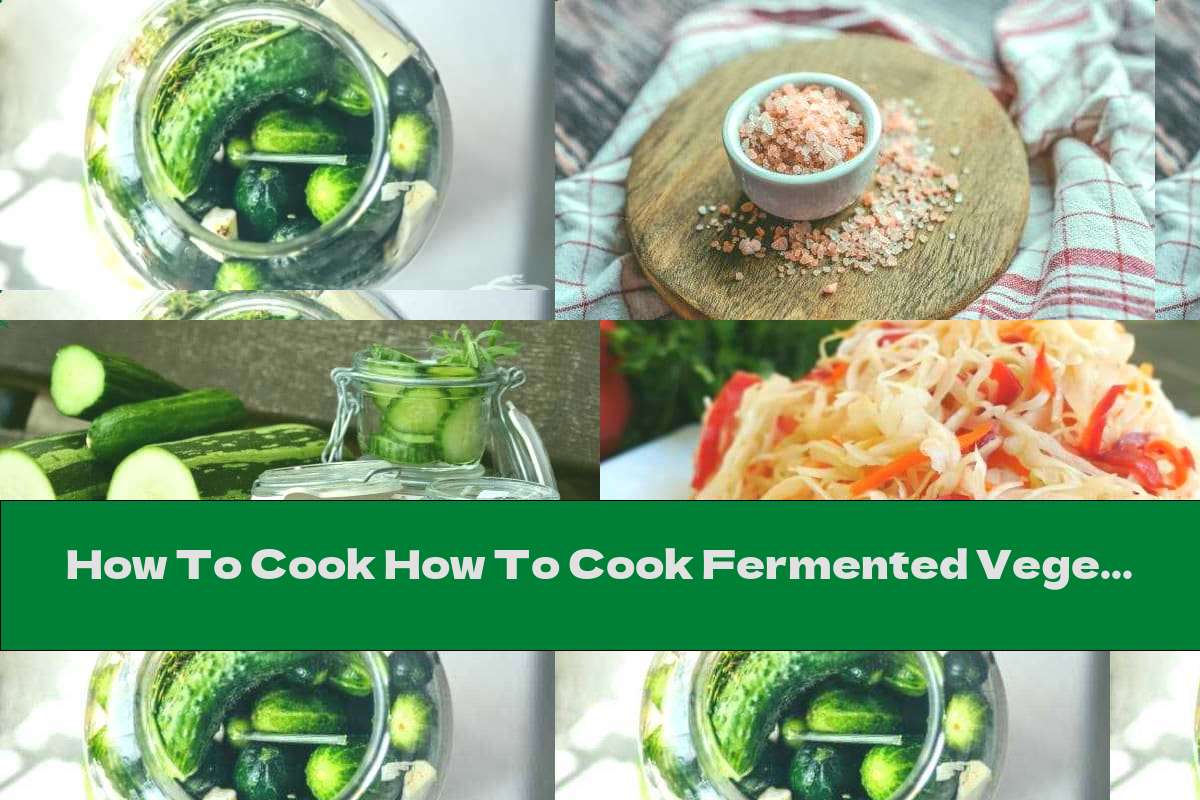
All you need are local, local products, a little personal time and desire. And it usually costs pennies. Take a walk around an autumn market and choose what to ferment - fresh tender cabbage, blood red beets, crispy green tomatoes, carrots and cucumbers, cauliflower, spicy peppers ... You can even try to ferment homemade apple cider vinegar yourself.
All these home-fermented foods multiply their nutritional value. The amount of vitamins and enzymes multiplies countless times.
There is a variety of fermentations of different foods (milk, fruits, drinks), but here we will touch on the natural fermentation of vegetables.
What is fermentation?
Fermentation is a completely natural process in which starch and sugars in vegetables are converted into alcohol, acids and gases, thanks to microorganisms, through lactic acid fermentation.
As a result, the foods that have undergone the process contain live bacteria with a probiotic effect and have a characteristic taste.
No acid, fat, sugar or stabilizer is used to make fermented vegetables and there is no heat treatment. And no, it has nothing to do with our well-known pickle. This is not a method of long-term preservation. It differs from winter food in the true sense of the word. Fermentation is a dose of natural "medicine".
Fermentation is a magic, literally, that happens before your eyes. It is not influenced by the exact recipe, it does not happen according to specific rules. From the same vegetables in different homes will develop different flavors, at different rates.
Fermentation is not similar to fermentation - it depends on the temperature in the room where the process takes place, on the lighting, on the quality of the material used, and even on the energy of the people who live at home ...
What can you achieve with regular consumption of home-fermented products?
Our immune system is concentrated in a large percentage in the gut, and if we take good care of the flora that lives there, we will get more nutrients from food. Which is actually more important than just being full. Fermented foods are rich in probiotic bacteria. By consuming them, we enrich our intestinal flora, which in turn increases the body's defenses to fight against invaders - viruses, colds, inflammation ... Because:
| "ALL DISEASES BEGIN FROM THE INTESTINE" Hippocrates |
Worn out, but a fact;)
The benefits:
- improving the intestinal microflora and colonization with beneficial bacteria;
- improving peristalsis;
- improving nutrient absorption;
- suppression of the predominance of pathogenic bacteria;
- improve digestion;
- increase the body's defenses.
What we need - vegetables of choice, water, salt and patience.
Sol
What salt? This is important, do not overlook. Forget about cooking fine and fine refined salt. Not just in this case, but in general. Bet on unrefined coarse sea, gray Celtic salt or pink crystals.
It is important not to use a little or a lot of salt. Less salt will give way to the appearance of bad bacteria that would interfere with our magic.
And can't you with a little salt? With too little salt, vegetables will become soft and mushy and fermentation may not occur at all.
Spices - your creativity is already underway here and any ideas can be useful. You can bet on basic recipes, but you can also put a pinch of imagination, creating new flavors, thanks to spices. With them you can create a different taste every time - black pepper, bay leaf, allspice, cloves, dill, cumin, turmeric, garlic ..... fresh green herbs, yes, even better!
Do not use metal utensils and utensils - ceramics and glass jars are ideal for the process. Especially when fermentation begins, do not press, do not mix with metal utensils - choose a wooden spoon or the bottom of a glass. Probiotic bacteria do not like metal.
Fermented vegetables
Easy and simple as child's play, with a million benefits.
- Cut the vegetables you choose into sticks, pieces or leave whole.
- Bring water to a boil, add salt, stir to dissolve the crystals.
- The general rule is - 25-30 grams of salt per liter of water.
- Let the brine cool completely. Pour over the vegetables.
Very important: vegetables must be absolutely immersed in liquid. Use a weight bag full of water to keep the vegetables away from the air - this is an important condition for fermentation, which occurs only in an oxygen-free environment. If there are vegetables on the surface, they will probably rot, develop mold and spoil the contents of the whole jar.
Tip : do not mix different types of vegetables in one jar. They ferment at different times and you may not get a satisfactory result.
After 3-4 days you can start trying your vegetables and decide if they are ready.
After the fermentation is over, when you decide that this is your taste - put the jar in the refrigerator, already tightly closed with a lid. Fermentation even in the refrigerator will continue to occur, albeit at a much slower pace. The taste will develop and enrich.
Try to consume fermented vegetables daily for maximum effect. Start with small doses of one spoon or several pieces a day. You can gradually increase the amount and include them in each meal.
It is! Simple and easy, probiotic without packaging and only for pennies.
Sour cabbage
The jewel in fermentation - sauerkraut. Cut as finely as possible - the finer the better. In a large non-metallic bowl, mash the cabbage by hand and coarse sea salt. It will start releasing fluid. Close with a lid and let rest for an hour. It will release more of its juice. That's exactly what we need.
On one medium head of cabbage use 25-30 grams of salt.
Take the cabbage in handfuls and squeeze the juice. Squeeze tightly into a jar. Stuff it well. Leave about three fingers of free space. Top with salted cabbage juice. It is very important that all the cabbage is immersed under the liquid and nothing is served. Close and wait ... Once a day for the first 3-4 days, open the cabbage to release the fermentation gases. Use the moment to press the cabbage down - by hand, with a wooden spoon or with the bottom of a glass.
The ideal temperature for fermentation is about 18-20 degrees. Keep the jar out of direct sunlight.
Fermented cabbage is great around the 7th or 8th day. But try, a lot depends on the material used and the temperature. If the room where you keep the jar is cold, it will take more time to ferment.
And yet - when is it ready? Sauerkraut is ready when it is tasty - it has a pronounced acidity. You can continue to ferment longer to give the cabbage a deep taste. But in almost all cases about 7 days from the beginning of fermentation it is ready.
Just when it is very tasty - transfer to the refrigerator to keep the taste as long as possible. Already moved to the refrigerator, it will remain edible for a month.
This is a basic basic simple recipe for sauerkraut, which you can always enrich based on your taste or experiment - you can add purple cabbage, garlic, grated carrots, various spices ... Experiment with the time of fermentation and different flavors.
And one more thing - although autumn is the boot of vegetables suitable for fermentation, in fact there is no season for fermentation! Don't limit yourself to the cold months. For a jar of sauerkraut you can always find a place on the kitchen counter, and the probiotic in it - in your stomach. Take it as prevention, not just food.
| Warning - if you have histamine intolerance, it is not recommended to eat fermented vegetables. |
- Beans with sausage and sauerkraut
- Pork with sauerkraut
- Sauerkraut with rice and topping in the oven
- Sauerkraut salad with carrots, parsley and sesame oil
Related Articles
- The Power of Honeysuckle: Health Benefits and Recipes
- Fruitskewers in Honey Syrup: Nutritional Benefits and Recipes
- Nutritional Benefits of Fruit Skewers in Honey Syrup: A Delicious and Healthy Recipe
- Nutrition Guide: Fruitskewers in Honey Syrup - Benefits, Recipes, and More
- The Role of Flour in Nutrition: Types, Benefits, and Recipes
Top Nutrition Articles Today
- . Grapefruit - For Colds And Flu
- . How To Cook The Most Delicious Potato Pancakes
- . How To Freeze Quince
- . Healthy Cupcake Recipes: Balancing Flavor and Nutrition
- . Foods High In Folate And B12
- . 10 Foods You Can Eat On An Empty Stomach
- . Healthy Cupcake Recipes: Nutritious and Delicious Treats
- . Chicory: 15 Health Benefits, How To Drink, Contraindications...
- . 5 Recipes For Potato Casserole In The Oven
- . Exploring Diet ÃƃƒÆ’Ãƃ‚¢ÃƃƒÂ¢Ãƃ¢â€šÂ¬Ãƃâ€...