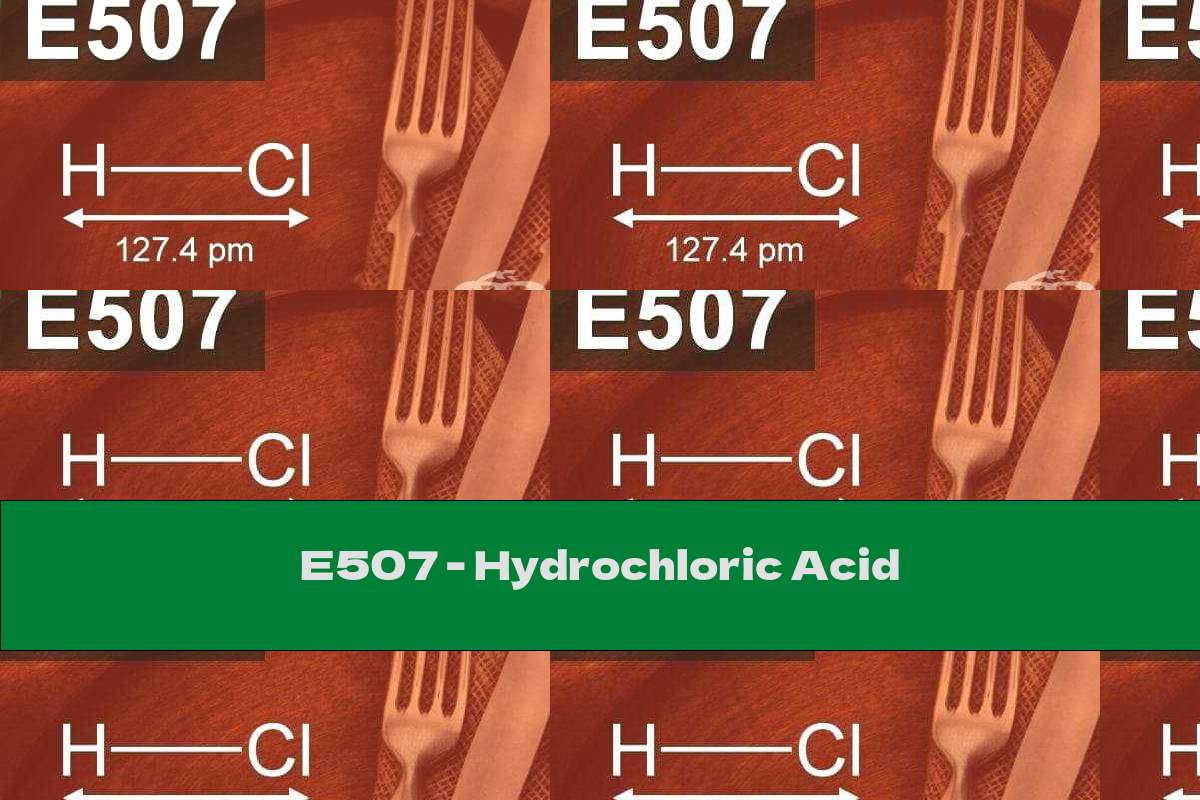
E507 - Hydrochloric Acid
 Author: Victoria Aly
Time for reading: ~1
minutes
Last Updated:
January 27, 2026
Author: Victoria Aly
Time for reading: ~1
minutes
Last Updated:
January 27, 2026
CHAPTERS (Table Of Contents)
Characteristic: Hydrochloric acid is a colorless sharp synthetic liquid, characterized by a sharp specific odor, the substance smokes outdoors. The boiling point for the various concentrations is between
Characteristic
Hydrochloric acid is a colorless sharp synthetic liquid, characterized by a sharp specific odor, the substance smokes outdoors. The boiling point for the various concentrations is between 48 and 108 degrees. It is usually obtained by dissolving hydrogen chloride gas, which in turn is obtained by burning hydrogen in chlorine. Rarely, the additive is derived from secondary gases released in various processes (exhaust gases). Hydrochloric acid dissolves well in water.
Use
In the food industry, the additive E 507 is mainly used in the form of 10% and 25% solutions. It is used in the production of some syrups. It can be found in the composition of mayonnaise, carbonated water, citric acid, fructose, gelatin.
In industry, hydrochloric acid is used more: in hydrometallurgy, galvanotyping; used for cleaning metal surfaces during tinning and soldering.
E 507 is also used in medicine. Basically, a weak solution of hydrochloric acid was prescribed to people suffering from diseases accompanied by insufficient gastric acidity.
The textile industry uses the additive for leather processing.
Impact on humans
Contact with hydrochloric acid can lead to unpleasant consequences. As this is a scorching substance, it should be avoided on exposed skin and mucous membranes, otherwise severe burns are possible. Acid is the greatest danger to the eyes. When unclogging pipes, channels, etc. with the substance, hydrogen chloride vapors are immediately released, a mist is formed, the inhalation of which leads to severe irritation of the respiratory tract, mucous membranes and shortness of breath. Interacting with bleach, potassium permanganate and manganese dioxide, E 507 forms a very toxic and dangerous chlorine gas. However, the weak solutions used in the food industry do not endanger human health in any way.
- E260 Acetic acid
- E210 Benzoic acid
- E200 Sorbic acid
- E120 Cochineal, Carminic acid
Related Articles
- The Ultimate Guide to Lactic Acid in Nutrition: Benefits, Food Sources, and Recipes
- The Role of Fatty Acids in Nutrition: Benefits, Sources, and Intake
- The Complete Guide to E952 (Cyclamic Acid) in Nutrition
- The Nutritional Benefits of Blubber: Omega-3 Fatty Acids and Vitamin D
- The Ultimate Guide to E330 (Citric Acid) in Nutrition
Top Nutrition Articles Today
- . How To Cook Spinach Soup With Corn Flour, Parmesan And Garli...
- . Is It Filled With Carbonated Water?
- . The 123 Approach to Nutrition: Benefits, Implementation, and...
- . Water Protects Against Diabetes
- . E515: Potassium Sulphates and Potassium Bisulphates - Functi...
- . Hydrochloric Acid in Nutrition: Importance, Effects, and Sup...
- . The Role of Disodium Diphosphate in Food: Uses, Health Conce...
- . Understanding E476 in Nutrition: Benefits, Foods, Concerns,...
- . Steroids in Eggs: Separating Fact from Fiction | Nutrition a...
- . How To Cook Caramel Cream Mousse (for Cakes And Pastries) -...