How To Cook Ten Tips For Making The Perfect Pancakes - Part One - Recipe
 Author: Joe Fowler
Time for reading: ~3
minutes
Last Updated:
August 08, 2022
Author: Joe Fowler
Time for reading: ~3
minutes
Last Updated:
August 08, 2022
CHAPTERS (Table Of Contents)
Learn how to cook "Ten tips for making the perfect pancakes - Part One". Delicious recipe.
To make delicious pancakes , not only desire and a little practice are needed, but we also need to know some subtleties during preparation that will give a perfect end product.
In fact, the principle is the same: we knead the dough, which we bake in a pan. But we should not neglect the following nuances ...
1. What pan to use?
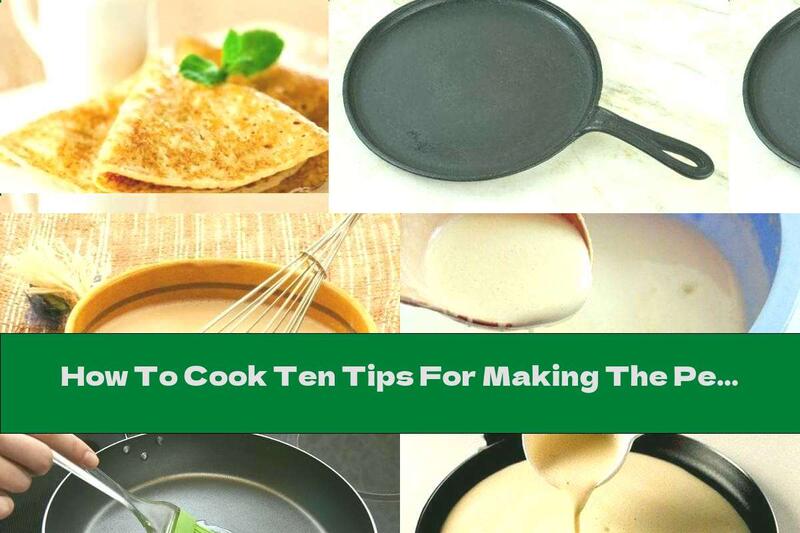
The cast iron version has been tested over time and has proven to be the most suitable for baking pancakes because it heats evenly and retains heat for a long time. The thick bottom allows the dough to bake well. Thanks to the porous surface of such a dish, an oil layer is formed, which does not allow the dough to stick to the pan and burn.
It is not recommended to wash the cast iron pan, only cleaning is enough. To do this, pour oil and sprinkle with 1 tablespoon of coarse salt. Then calcine (heat for a long time), allow to cool and then wipe thoroughly with paper or dry cloth. If necessary, repeat the procedure.
The disadvantage of this vessel is its weight. Modern products with non-stick coating are more practical, but the main thing when baking pancakes is that the bottom is thick, the walls are low, and the handle is long and comfortable.
2. How to make a suitable dough?
There are many recipes for making pancake batter. Which one you choose is a matter of taste, but they all have one main product and that is flour. It must be sifted. This will not only clean it of lumps and impurities, but will saturate it with air, which is important for obtaining a light and fluffy dough.
As for eggs and milk, we must say that it is best to keep them at room temperature, so take them out of the fridge for a while before you start making the dough.
It is recommended to break the yolks and whites separately. The proteins, turned into a fluffy foam, are added last to the dough so that it can become "lacy".
Pour the flour gradually and carefully, stirring constantly. Of course, it is first necessary to mix the liquid ingredients.
Don't forget to add a pinch of salt, even if you decide to make sweet pancakes. It gives an interesting and rich taste.
Another subtle point is the use of a little oil. This will make the dough stick to the bottom of the pan less and you will have to grease the pan less often.
A sign of properly freshly kneaded dough is the appearance of small bubbles on its surface, which gradually disappear.
3. What should be the consistency of the dough?
The rule for the golden mean is important here: the dough should be neither too thick nor too liquid. The ideal consistency is resembling liquid sour cream or thick liquid.
Do not spread the dough in the pan either fast or slow. Accordingly, in one case it is necessary to add more flour, and in the other - dilute with warm water (it not only improves the density, but also has a good effect on the taste of the finished pancakes).
4. How and with what to grease the pan?
You can use sunflower oil, cow's or melted butter, bacon or other animal fat to spread on the bottom of the dish. To distribute the selected product evenly, you can bet on half an onion or cut into two raw potatoes, which you stick on a fork. Of course, silicone brushes that are convenient for this purpose are also available on the market today.
Whichever "helper" you choose, it is important to apply the fat not only on the bottom of the pan, but also on its walls.
5. How and how much dough to pour into the bowl?
The thickness and taste of the pancakes depend on the amount of dough that is put in the pan. You need to match the volume of the ladle you will use to the size of the pan and find their ideal ratio.
For example, for a medium pan with a bottom diameter of 20 centimeters, 1 ladle holding 140 milliliters of dough is quite sufficient.
The most common ways to pour the dough are two: in the middle of the dish or starting from one raised end of the pan. In both cases you need to distribute the mixture evenly. To do this, quickly and carefully tilt the pan slightly in all directions, making clockwise movements.
- Pancakes without eggs
- Mini pancakes with homemade strawberry jam
- Pancakes with corn flour
- Original American pancakes
Related Articles
- The Power of Honeysuckle: Health Benefits and Recipes
- Fruitskewers in Honey Syrup: Nutritional Benefits and Recipes
- Nutritional Benefits of Fruit Skewers in Honey Syrup: A Delicious and Healthy Recipe
- Nutrition Guide: Fruitskewers in Honey Syrup - Benefits, Recipes, and More
- The Role of Flour in Nutrition: Types, Benefits, and Recipes